If you’re peeing your pants, friends, tell somebody.
Laugh about it, sure. Make light of it, fine. But for f*cks sake, do something about it. Do not suffer in silence. Do not just accept it as part of the deal of having had kids. Because it is not part of the deal. It is fixable.
I have been saying this for over twenty years. And I will keep saying it until every woman who has ever quietly crossed her legs before sneezing knows that she does not have to live this way.
So what the hell is the pelvic floor anyway
Bear with me here, I’m going to give you a visual.
Remember those old paper towel commercials? One brand would hold up just fine when you poured water on it. The cheaper one would separate and fall apart. Picture that as your pelvic floor. The good one holds. The cheap one doesn’t.
Your pelvic floor is a group of muscles at the base of your pelvis. They support your bladder, your uterus, your rectum, your intestines, all of it. They are literally holding your organs in place.
During pregnancy, the weight of a growing baby puts constant pressure on those muscles for months. On top of that, hormonal changes cause everything to loosen and weaken. And then delivery, whether you pushed that baby out vaginally or had a C-section, adds another layer of trauma to muscles that were already working overtime.
When those muscles get weak, things start to shift. Organs can prolapse. And the muscles that used to keep your bladder closed? They stop doing their job. So when you sneeze, cough, laugh, jump on a trampoline, you leak.
The trampoline story
I had a client who took her kids to a trampoline park for a fun day. She thought it looked like fun, figured she’d join them. On her first jump, she completely emptied her bladder. Through her pants, through everything. She didn’t have a change of clothes. Day over.
I have heard this story more times than I can count. Different women, different trampolines, same ending. And every single time I hear it, I think: she shouldn’t have to live with this. None of you should.
That story, honestly, is a big part of why I opened my first Pilates studio in 2015. Why I created courses around this. Why I wrote the book. Why I’m sitting here talking to you about it right now.
Kegels are not the answer. At least not the whole answer.
Here’s where I get a little fired up.
A lot of women go to their OBGYN or primary care doctor, mention that they’re leaking, and get told to just do kegels. And yes, kegels have a place. They are a great internal vaginal contraction that can strengthen the vaginal canal. But it is not the end-all-be-all. Not by a long shot.
I actually had a course called Think Beyond the Kegel. Because that’s exactly what you need to do.
Your pelvic floor does not exist in isolation. If you have bladder leakage or prolapse symptoms, you also need to look at your deep abdominals, your hip muscles, your glutes, specifically the gluteus medius and gluteus minimus, those smaller muscles on the sides of your hips. They support and stabilize your pelvis. They keep everything in alignment. They play a direct role in keeping your pelvic floor functioning the way it should.
And here’s something your doctor probably didn’t mention: sometimes the pelvic floor is not too weak. Sometimes it is too tight. An overactive pelvic floor can also cause leakage. A physical therapist who offers internal vaginal assessment can actually test your Kegel contraction and tell you which situation you’re dealing with before you start your strengthening practice.
What actually works
My go-to is always Pilates. Not because I’m biased, although I have been teaching it for over twenty years, but because it does something that most exercise approaches don’t. It works the deep, slow-twitch muscle fibers. The foundational muscles. The ones that actually support your body long term, not just the big bully muscles on the surface.
It is gentle. It is not jarring. It does not require you to destroy yourself to get results. And it addresses the whole body, pelvic floor, deep core, hips, alignment, all at once, so nothing gets worked in isolation and everything stays in balance.
Breath work matters too. Pelvic tilts. Targeted exercises that might seem boring but absolutely get the job done.
If Pilates isn’t accessible to you right now, physical therapy is a solid option. Just make sure you find a provider who is actually going to dig into the root cause and not hand you a pamphlet about kegels and send you on your way.
The thing I need you to hear
Whether you had one baby or five. Whether it was two years ago or twenty. There is still hope. These muscles can be strengthened. These symptoms can be significantly reduced or eliminated entirely. It is not too late.
You are running businesses, families, households, communities, school schedules, basically everything. You should not have to do all of that while also worrying about whether you’re going to leak at the gym.
I’m not okay with that. And I don’t want you to be okay with it either.
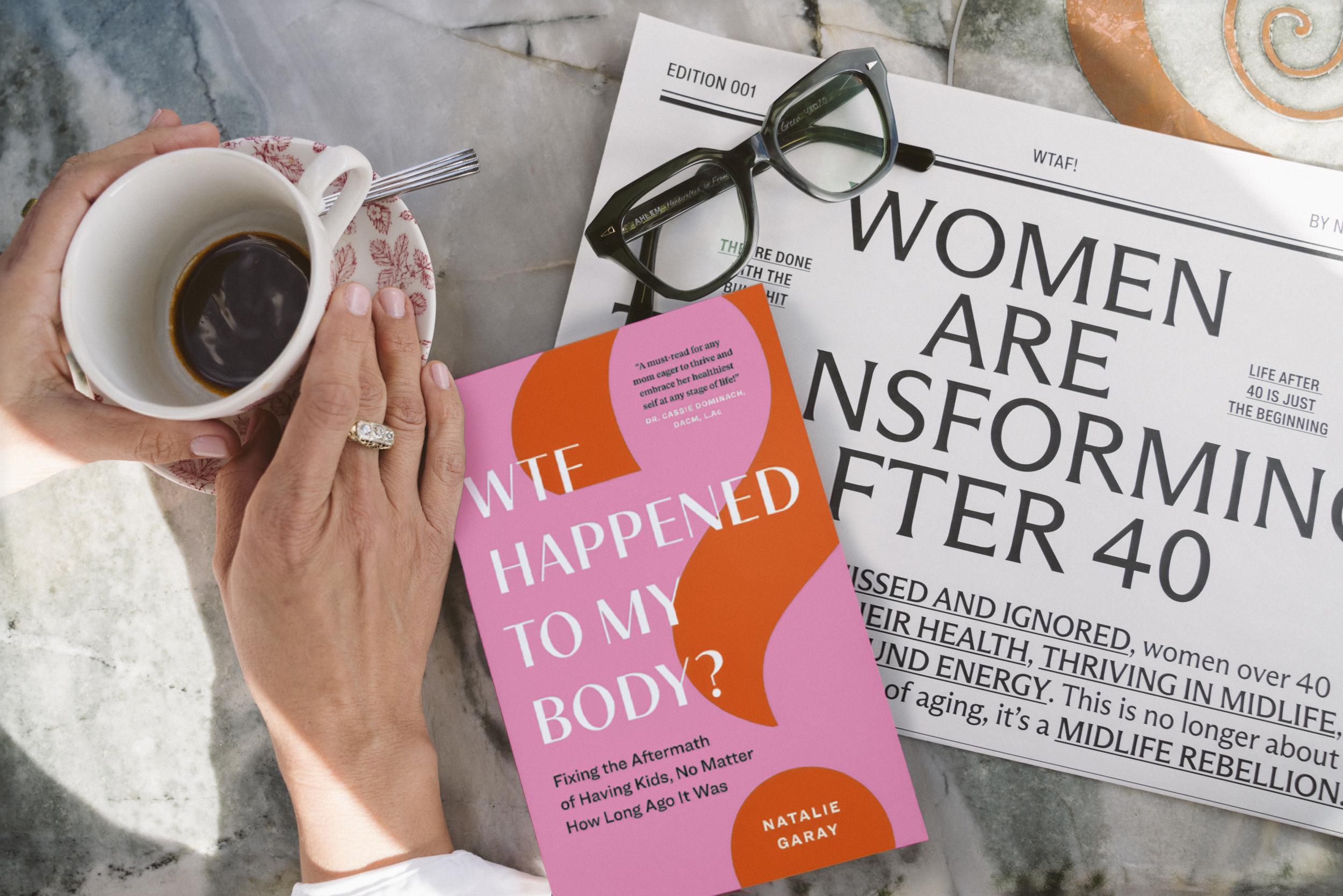
My book WTF Happened to My Body? Fixing the Aftermath of Having Kids No Matter How Long Ago It Was has exercises specifically for pelvic floor rehabilitation with linked videos so you can actually see what you’re doing and get started today.
And if you have questions, or an embarrassing trampoline story of your own, find me on Instagram @nataliesayswtf. I want to hear from you.
Fix it, sister. You’ve got this.
Natalie Garay is an author, podcast host, and future naturopathic doctor focused on women’s health after 40. Her book WTF Happened to My Body? is available now in paperback, Kindle, and on Audible.
Listen to the full episode on Spotify or Apple Podcasts.

0 Comments
Leave a comment